
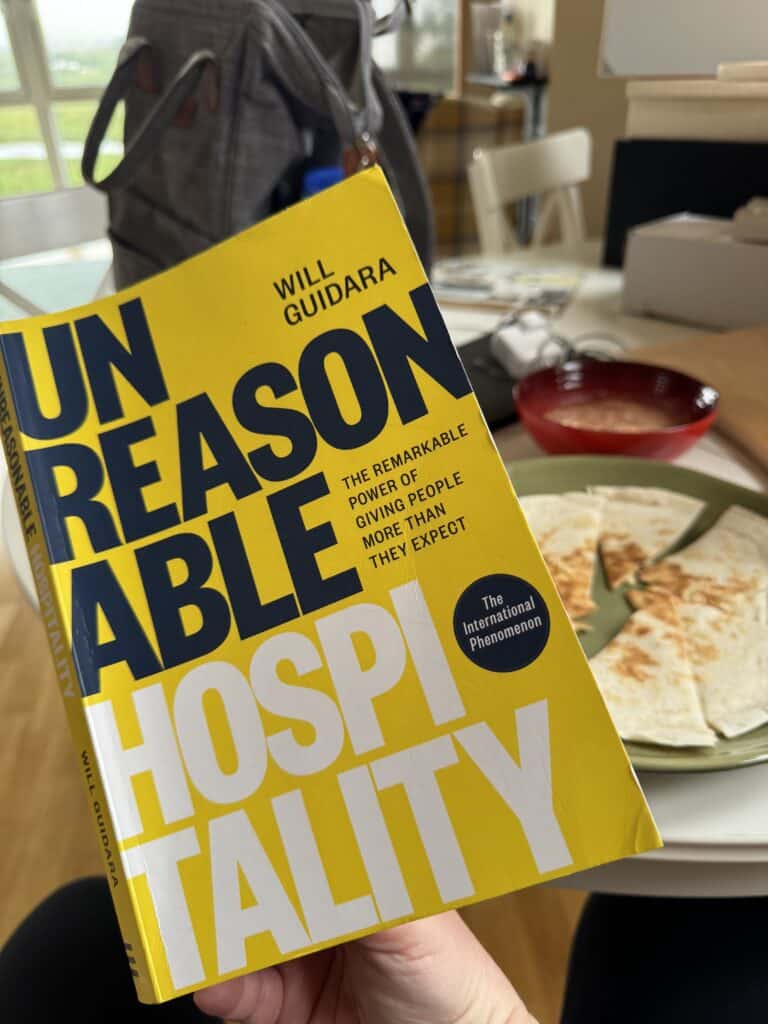
As you may have seen on LinkedIn this week, I’ve started a book club for one.
Or two, or three, if any of you want to join.
I pick a book I’ve been meaning to read, place it on my dining room table, and read a small portion of it each day when I have lunch.
This month’s book was Unreasonable Hospitality by Will Guidara. I’d heard good things from multiple people – other business owners and clients – so I’d had it on my list for ages. I even did that thing where you carry it about on your travels, hoping it will inspire you to pick it up whilst on the train or waiting for a ferry. I did a little of that, but the daily habit of having the book in reach was more helpful in the long run.
Here are a few of the principles I picked up from it:
It’s less important to be right, than for the client to be delighted.
This one was a little harder to translate into my marketing agency (and perhaps to your accounting firm). The story Will tells of the server who corrected a guest about the difference between medium rare and medium, and how the point was that the guest got what they wanted, not necessarily what they ordered, works well in a restaurant environment. It doesn’t matter in the long run if the guest doesn’t fully grasp the true culinary meaning of ‘medium rare’. But in a marketing agency, we do a lot of education. A big part of our relationship with clients is helping them understand how SEO & AEO actually work, or what a Claude-built website might be missing, or the different kind of posting you do on LinkedIn versus Instagram. And yet…if the client posts “the wrong way” on LinkedIn and ultimately gets the right kind of clients from it…are they “wrong”? Does it matter? This one made me think a lot about what “delight” means for our clients – and how to check the ego at the door.
Successful people have plenty of failures: it matters to share them.
Will’s book is full of personal stories about times he got things wrong – it even begins right at chapter one with the fact that they came in dead last on a top list of 50 best restaurants, and they used that as fuel to improve. Or how he failed to trust his team, and what it cost him and the restaurant. Most business books are full of “I failed a little bit once or twice but ultimately I’m really wise”, and Will’s book felt more like a real human person who did a lot the world considers successful…and also really messed up at times. He doesn’t take all the fails on himself, either: he shares stories of times others in his restaurant got it wrong, and how he dealt with it when they did. Fails are absolutely normal: and despite the showreel we see on social media, each one of us are daily managing our own. From time to time, it’s helpful to share them. I recently was a guest on a podcast in which I tell the story of my substantial failure to run a 21-person agency. How I ended up having to let 13 people go all at once, and most of the rest of that team left soon after, and I had to rebuild the entire business. I felt like the world’s biggest failure. Some people were really very unhappy with me. But two years later I’ve got much more of the company I wanted, and my lesson was that just because something is the right decision doesn’t mean it will always feel good to do it. (Drop me a reply if you’d like a link to listen once it comes out.)
More isn’t always better: sometimes it’s just a big production.
There was a time in the restaurant when Will and his team were adding more, and more, and more. Complete table service changes with every course. Fourteen courses. Flourishes. Speeches. But after a pretty terrible review they were reminded that what people want is space to enjoy their food and good company. The bigger the production, the less you actually remember the experience. As you’re looking at your business, think about whether you’re adding more that the client cares about, and is delighted by; or if “more” (whether it’s new advisory reports or an app you’ve built or a comprehensive onboarding system) is just…a big fancy production.
Train the team well, and give them room to make judgment calls by type of client.
Some tables want interaction and banter from their server; others want to be left to have good conversation. There were a few failure stories related to times when the servers had speeches to prepare and systems to follow; and yet, what people were delighted most by was a small gesture, a personal comment, a conversation with the server related to their experience and their time in New York. Will realised that by giving too detailed of a system to the team, he was removing the opportunity for the server to make a judgment call and give the guest an even better experience.
Overall I’m still not sure whether this is a book for the whole team to read and come up with ways to delight clients; or whether it’s better for managers to read, and think about how they lead the team. Either way, there are some good reminders in here about what our clients really want, and how to connect a fantastic system and good ingredients with a real human experience.
After all, with all the AI flying about, the human experience matters more than ever.