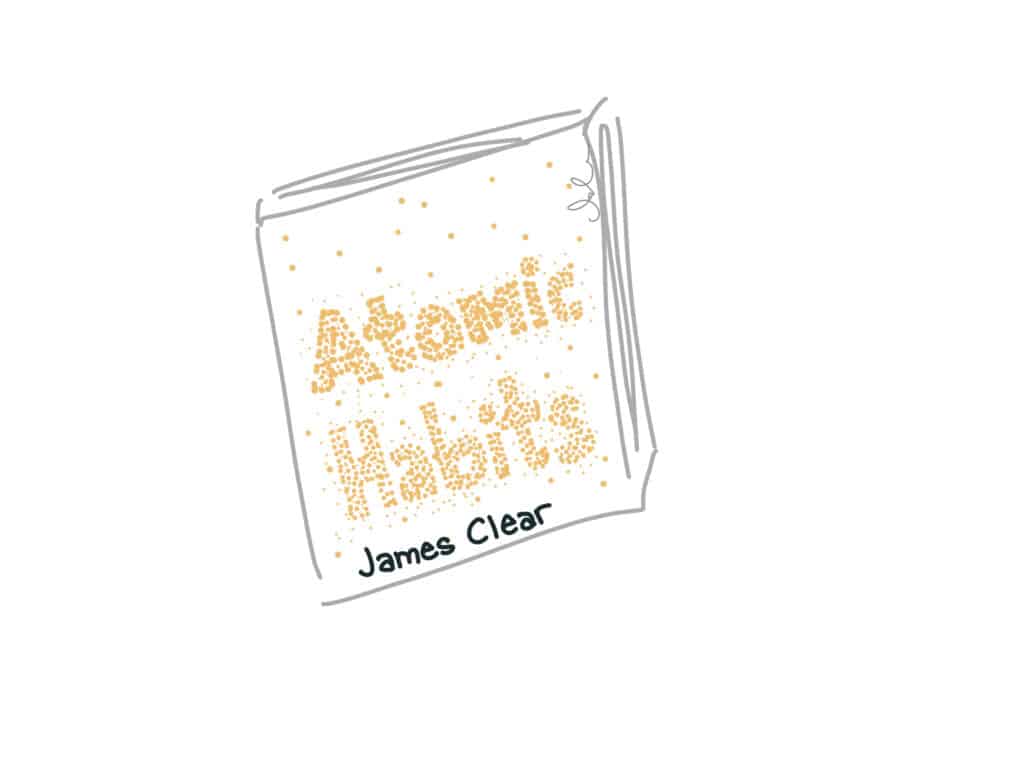
I used to think Atomic Habits had changed my life. I pretty much said that in this review I wrote in 2023. Then I discovered the If Books Could Kill podcast, listened to their take on it, and realised how it addressed those niggling feelings I had about some of its advice – and why in the long run, a lot of its advice wasn’t working for me.
Atomic Habits has some good advice, and it’s also flawed.
When I first discovered the book I loved it. Loved the concept, loved the idea that by improving small things I could see big (atomic level) results. (I wrote this review of the Atomic Habits book in 2023 and claimed it changed my entire life. I won’t edit or change that post but this new one reminds me that it takes years to see if changes truly last.)
We know experientially that principle of improving in small increments is true. Want to be healthier? Make small changes to your eating or exercise habits, day after day. Want to read more books? Read a few pages of one every day. Want to send a Creative Headspace email every week? Sit down every Saturday and get it out there. And so on.
But as I attempted to follow the atomic habit principles, I hit a few roadblocks. At first I thought it was just me. I wasn’t following the process right, or well. I was the lazy one and it was my fault. Everyone else was doing it right, or better, and here I was failing, day after day. Not even failing in a big way. Failing to reach the 1%, which is super tiny.
I tried to follow the “don’t skip twice” philosophy when it came to walking. For a full year I walked literally every single day. I missed a few, but i never, ever skipped twice. I remember dragging myself out of bed at nearly 11pm after being horrendously ill and exhausted all day, just to make sure I got my walk in for the day.
I was a champion. I was building my atomic habits. I wasn’t going to let a day of illness crush my goals. No ordinary life for me.
But I’ve been thinking a lot about my goals, and my life, and whilst I want to be a person of consistency and achieve my goals, I also want to be someone who values rest. Someone who knows when to stop. Who leaves room for reality, and broken down ferries, and illnesses, and torrential rainstorms with lightning. Sure, I could drag myself out in the midst of a lightning storm (did that) so I got my walk of the day…but maybe all I’m becoming is a rule follower.
So I listened to the podcast (here it is) and I did find it well balanced. There are good points in Atomic Habits, and some of the principles are solid ones we’ve seen work in business and sport and life. Ultimately the podcast hosts agreed that it’s not about what’s “true or false” with some of these principles – it’s just a way of looking at things.
And in some areas that way is flawed.
These are the ones that stood out to me:
The concept of the 1% increases is right, but it needs to apply to multiple areas.
The idea of improving something by 1% every single day sounds really appealing, and doable. It’s so small! Just a little bit, every day. You improve your cooking by 1% every day, or your cleaning, or writing, or your approach to sales. “But there’s no skill that you can improve 1% every single day for 365 days,” the podcast hosts said. “It’s a ridiculous concept. This is just taking the idea of compound interest and pretending that it applies to skills.”
They point out that this 1% concept in the book is applied indiscriminately to skills and habits. Cooking is a skill. Smoking is a habit. If you try to apply the 1% to cooking, you’ll improve the knives you use, the kitchen you cook in, the quality of the butter, the technique with the chopping, and so on.
But if you try to apply this to a literal addictive habit, like smoking or gambling or alcohol, you’re going to hit roadblocks because there’s a whole different game going on in your mind. Not to mention things like generational trauma, family or health situations, and access to resources. Which leads us to the next point.
It doesn’t take into consideration the impact of investment or privilege.
In shocking news, a book written by a middle aged white man neglected to consider the impact of privilege, the way different people are wired, or what they do and don’t have access to. This was the biggest one for me, the “aha” moment as I listened to this podcast and thought about my feelings of shame when I wasn’t improving by 1% every day.
The podcast hosts read out the example used in the book about the British cycling team, making small improvements to their cycling so they could become champions. The biggest fact missing from this story was that the British Cycling team – in addition to getting a new coach who promotes this concept of marginal gains – also gets a massive increase in funding. The UK instituted the National Lottery and started apportioning out proceeds…so by the time the cycling team is looking at applying these marginal gains, they’re receiving 2.5 million pounds every year.
That makes a serious difference.
If you’re going to bring your own mattresses so you sleep better, and have a doctor on-hand for every trip, and improve the quality of the bikes you ride, having an extra few million isn’t simply a philosophical change. The cyclists were trying hard and making changes and improving as much as they could: but it’s also no coincidence that their very first gold medal in nearly 100 years happened to coincide with a life-changing increase in funding.
It doesn’t take into consideration education and access.
They tell another story from the book, about testing the efficacy of antibacterial soaps, and how the way the story is told it makes it sound like because the soap foamed easily and smelled nice, people enjoyed using it more. This made the habit of hand washing more satisfying and all these illness and infection rates dropped.
The truth is the researchers provided training – going round to people and checking on how they were doing. Showing them how to use the soap and persistently educating them about why it’s more effective. And – this is the kicker – LITERALLY GIVING THEM FREE SOAP.
The example the podcasters used was to imagine if you wanted to eat more fruit and vegetables, and a basket of fresh fruit and veg appeared at your door (at no cost) every morning. Oh, and a chef would appear at dinner time and explain each vegetable and how it affected your body, and which ones to use in what way. Would you end up eating more fruit and veg? You’re damn right you would…because of education and access.
It doesn’t consider how some people are wired.
Another eye opener for me was pointing out that the book starts with this whole story about James getting hit on the head with a baseball bat when he’s younger, and then he goes on to explain that when he got to college he started improving his baseball playing habits.
But the thing is, the getting hit on the head didn’t change anything. It didn’t make James any different, or cause him to go from ‘someone who never had habits” to someone who started slowly, painfully developing them. He wasn’t someone who got hit on the head with a bat, lost his eyesight, and had to give up the game and learn another skill instead.
There was no suffering, no transformation story. He simply…started realising he was someone who had good habits, and he used those.
The reason this is a problem is the whole book is built around what James already finds fairly easy to do. If you are someone who lives your life by habits, then yes, applying the principles of atomic habits will be fantastic for you. If you’re someone who is really disciplined, and loves order, you’ll be able to keep lists and tick them off. But if you have a condition or an illness or you’re simply wired differently, you’ve got to have a different way to approach it.
And the atomic habits approach will fail you – like it failed me. You’ll hold yourself to this impossible standard, essentially trying to make yourself like James.
Whereas what you really need to do is figure out what’s the best of you, and lean into that. I remember working with a coach who tried to get me to do time blocking and always work on the same thing at the same time of day every week. I said listen with the greatest respect, after a lifetime of getting to know myself I can tell you right now that will never, ever happen. I like rhythms and routines: but they work for me when I can shift them, or break them, or move them around. I do my darndest to send these Creative Headspace emails every Saturday morning; but I don’t sit here on a Saturday morning at 7am every week writing them. Some weeks I write three at once, and schedule them ahead. Other weeks I write them on a Sunday, or another day. Sometimes on my phone while on a train. And some weeks (gasp) I just skip it because I’m tired or I want some actual head space or I just forget.
So turning me into someone who never skips twice, who habit stacks and keeps daily records and starts running in the morning, is not only unreasonable – it’s a recipe for disaster. Instead, I’m far better off thinking about what my defaults are, and how I’m wired, and how I can apply these principles (some of which are quite good) to my personality and approach to things. That’s more sustainable, and it’s more realistic.
No suffering, no transformation.
We did an internal skills training in my agency on case studies, and storytelling. And the line that stuck with me was “No change, no story”. If you’re trying to tell a case study, and you aren’t able to point to something that was like that at the beginning and it’s like this now, and there was a (usually long) process in between to get there, you don’t have a story.
James doesn’t have a transformation story.
As we noted above, he’s always been someone with good habits, and he simply…used those a bit more. And blogged about it, and then turned it into a book.
Sure, he writes about how he tried to build this habit or that one and it was hard, and he failed for a bit, and then he figured it out. But ultimately there is no suffering that we can relate to. He’s a skilled, talented person with education and investment available to him, and he used those things. Good for him. But it doesn’t make for an inspiring story: it’s just some pretty decent concepts, many of which can work, packaged together in a book of blog posts.
So if you, like me, have at times wondered why you haven’t quite implemented Atomic Habits quite as…atomically as you expected, maybe this is why.
Look at how you’re wired and your education and resources, consider your own suffering and transformation story, and give yourself a break. Keep using these principles in certain areas of your life – but apply them in a way that fits you. No need to be James: be the best version of yourself, instead. I promise you it’s a better way to build those habits.